My impressions about Blogger
My impressions about Blogger are mostly positive. I think the idea of introducing Blogger in our student’s daily life is good. Blogger is a great way for people who are sick to know what happened in class. It also helps clarifies some things you couldn’t understand in class. It is also a way to learn. I also like the fact that Blogger’s interface is easier and nicer than the one in Moddle. Blogger is also like a general base of everything we covered in Science, it is here if you want to print some courses you lost a long time ago. For the negative effect one of them is that Blogger can sometimes don’t save what you wrote in comment which makes it pretty annoying. But in overall all the comments arrive safely to Ms. D. An other negative things about Blogger is the picture manager which is very frustrating, you can’t do everything by yourself, you have to use some standard created by Blogger which decrease the liberty that you want to put in your post.
Showing posts with label Kamil. Show all posts
Showing posts with label Kamil. Show all posts
Thursday, June 3, 2010

Thursday, April 15, 2010
Let's talk about Astronomy and what could happen to us
,Today in class we mostly talked about the notes that each of us had to do for our celestial body project. We were having a forum and the students and Ms.D were asking questions to each other about their planets. During this class we mostly focused on the Sun (Kamil), the meteors etc, the comets and the asteroids.

For the Sun we first learned that G2V means that it is a spectrum star which arrived at half of its life. The Sun is a G2V star. We also learned that the sign of the Sun which is a circle with a dot inside comes from the Egyptian god RA. At the end we arrived to the fact that the Sun was created 4.5 billions year ago and it will die in 4.5 billion years ago, which makes it a middle star age.
 After with Severyn we learned that the golf of Mexico was made due to a meteorite. This meteorite is also probably the cause of the end of the dinosaurs. Here are the definition and difference between meteors, meteorites and meteoroids.
“Meteoroids are small bodies that travel through space. Meteoroids are smaller than asteroids; most are smaller than the size of a pebble. Meteoroids have many sources. Most meteoroids come from asteroids that are broken apart by impacts with other asteroids. Other meteoroids come from the Moon, from comets, and from the planet Mars.”
“A meteor is a meteoroid that has entered the Earth's atmosphere, usually making a fiery trail as it falls. It is sometimes called a shooting star or a falling star.”
“A meteorite is a meteor that has fallen to Earth. These rare objects have survived a fiery fall through the Earth's atmosphere and have lost a lot of mass during that process. Meteorites are made up of rock and/or metals.”
For these to be fire ball it has to be really big and brighter than Venus (magnitude -4).

After we talked shortly about comets (Cornelia) and what they are. Here is the definition of a comet.
“A comet is an icy body that releases gas or dust. Most of the comets that can be seen from Earth travel around the Sun in long, oval orbits. A comet consists of a solid nucleus (core) surrounded by a cloudy atmosphere called the coma and one or two tail.”
After this we moved on to Asteroids (Emma) and started with a scary subject which was that we could die in 2036 because an asteroid could crash. The day when the Asteroid will go into or pass near the belt should be Friday, April 13, 2029! The way it will go will persist of the angle the regions that can receive it are North America, Monsoon Asia or the Pacific Ocean which will make it produce a big tsunami that will be enormous compare to the tsunami in Indonesia in 2004. Asteroids are basically very very big meteorites.
Here is a simulation of the asteroid

We also spoke about terrestrial planets which are planets that are composed. These are the following terrestrial planets in our Solar Galaxy: Mercury, Mars, Venus and Earth.
The opposite of these planets are Gas Giant planets which are planets composed of gas. These are the following gas planets in our Solar System: Jupiter, Saturn, Uranus, and Neptune.
Remember to check Moodle; we got a lot of stuff to do!
http://zagreb.ceesa.net/course/view.php?id=106 <=== Science Course
Nest Sribe is Gregor
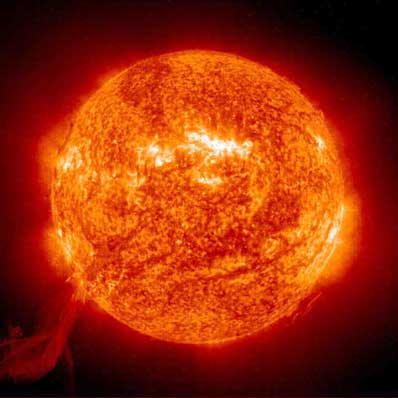
For the Sun we first learned that G2V means that it is a spectrum star which arrived at half of its life. The Sun is a G2V star. We also learned that the sign of the Sun which is a circle with a dot inside comes from the Egyptian god RA. At the end we arrived to the fact that the Sun was created 4.5 billions year ago and it will die in 4.5 billion years ago, which makes it a middle star age.
 After with Severyn we learned that the golf of Mexico was made due to a meteorite. This meteorite is also probably the cause of the end of the dinosaurs. Here are the definition and difference between meteors, meteorites and meteoroids.
“Meteoroids are small bodies that travel through space. Meteoroids are smaller than asteroids; most are smaller than the size of a pebble. Meteoroids have many sources. Most meteoroids come from asteroids that are broken apart by impacts with other asteroids. Other meteoroids come from the Moon, from comets, and from the planet Mars.”
“A meteor is a meteoroid that has entered the Earth's atmosphere, usually making a fiery trail as it falls. It is sometimes called a shooting star or a falling star.”
“A meteorite is a meteor that has fallen to Earth. These rare objects have survived a fiery fall through the Earth's atmosphere and have lost a lot of mass during that process. Meteorites are made up of rock and/or metals.”
For these to be fire ball it has to be really big and brighter than Venus (magnitude -4).

After we talked shortly about comets (Cornelia) and what they are. Here is the definition of a comet.
“A comet is an icy body that releases gas or dust. Most of the comets that can be seen from Earth travel around the Sun in long, oval orbits. A comet consists of a solid nucleus (core) surrounded by a cloudy atmosphere called the coma and one or two tail.”
After this we moved on to Asteroids (Emma) and started with a scary subject which was that we could die in 2036 because an asteroid could crash. The day when the Asteroid will go into or pass near the belt should be Friday, April 13, 2029! The way it will go will persist of the angle the regions that can receive it are North America, Monsoon Asia or the Pacific Ocean which will make it produce a big tsunami that will be enormous compare to the tsunami in Indonesia in 2004. Asteroids are basically very very big meteorites.
Here is a simulation of the asteroid
We also spoke about terrestrial planets which are planets that are composed. These are the following terrestrial planets in our Solar Galaxy: Mercury, Mars, Venus and Earth.
The opposite of these planets are Gas Giant planets which are planets composed of gas. These are the following gas planets in our Solar System: Jupiter, Saturn, Uranus, and Neptune.
Remember to check Moodle; we got a lot of stuff to do!
http://zagreb.ceesa.net/course/view.php?id=106 <=== Science Course

Nest Sribe is Gregor
Wednesday, April 14, 2010
Reflection Post Kamil
I think that using Blogger for our class is a great idea because it really helps people who are sick by giving them a summary of the class. It is also a great way to study for a test and to discover other people in the world.
What I don’t like with Blogger is that putting a picture correctly in a scribe post is complicated. The hardest thing with blogger was to arrive to write comments that weren’t repeating the comments of other people.
Overall I think Blogger is a good experience for the class and it learn how to manage a blog for the one that don’t know how
Subscribe to:
Posts (Atom)

